journal/

on-going mostly unedited stream of thoughts

The day that changed me

Connecting the dots from reclusion to activism
Then

I have never been active in local politics or activism, and I doubt that I will ever be.
– 22nd of April 2009

Now

Or can we pass them a school in the cloud, a better-designed political system or finally, actionable solutions and a more empathetic society to reduce the poverty gap so we can all grow up to be giants and creators?
– 19 of January, 2014

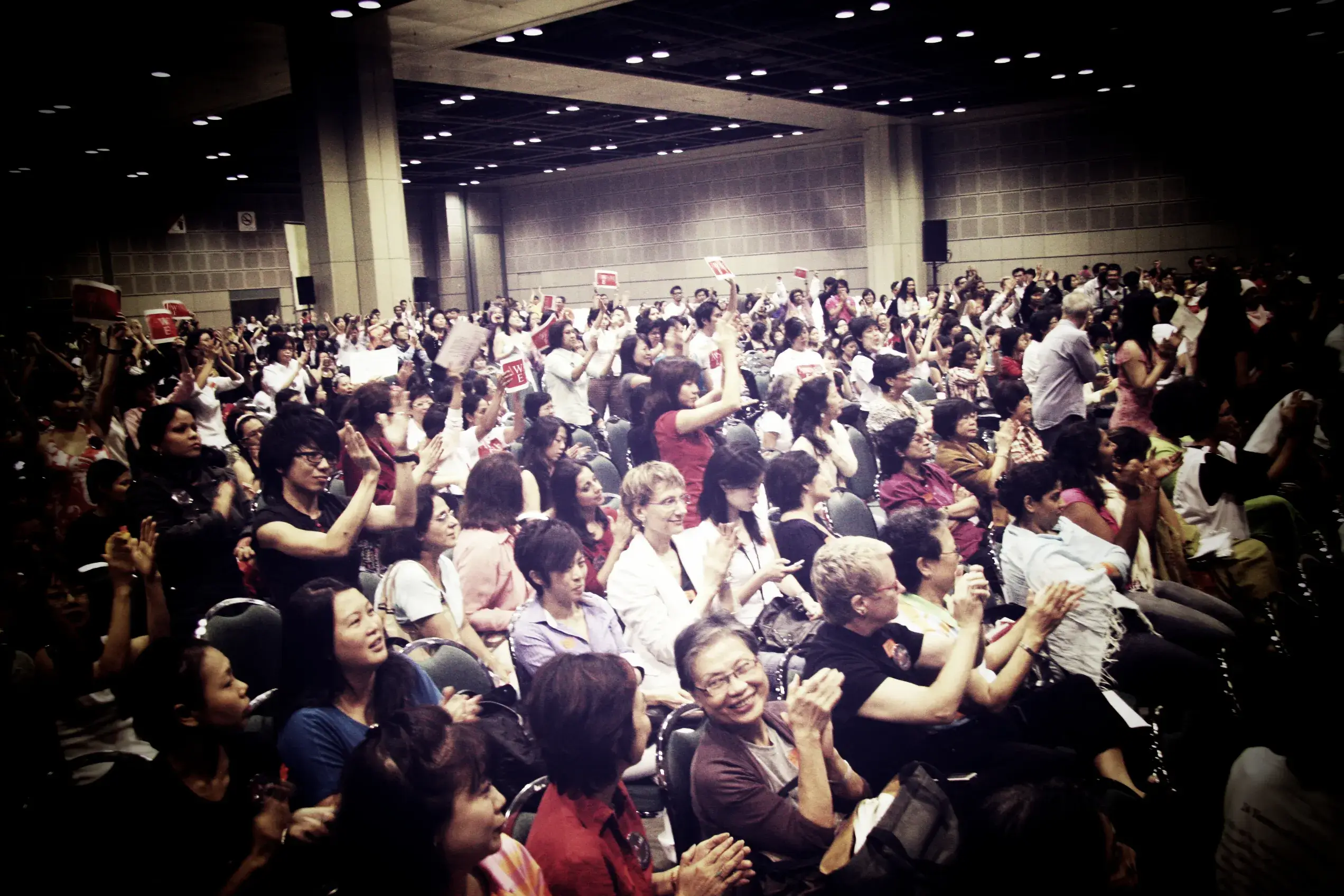
It was 2nd of May, 2009 at Suntec City, Singapore. The hall was filled with more than two thousand people and we had all been there for more than seven hours.

News had originally broken weeks earlier on Facebook and Twitter, that there was a hostile takeover at the Annual General Meeting of AWARE. AWARE, a non-profit organization advocating for gender equality was taken over by a group of women from a church with a very questionable position on the rights of women. It was surreal.

I was apathetic to it for a while. This is what comfort and peace does — we lose sight of how hard the people before us had fought to give us basic rights. I remained unmoved, until the people I respected and followed on Twitter started to lend their voices.

It was purely out of curiosity at first. What exactly happened? Why is it so important that we take notice? Why is it important to me? There was a certain momentum as the social media movement started to turn its gears. I was taken up by that momentum, as I sought to do my part in disseminating the answers I had found to my questions. I became an armchair activist, doing everything I could on Facebook and Twitter to raise awareness. Our rights have to be fought for, to be protected, to be preserved. They are there because some of us spend our entire lives protecting them.

An Extraordinary General Meeting was called, set on 2nd of May, 2009. They were hoping to pass a motion of no-confidence in the newly elected board. Our momentum gathered more speed as we tried to rally more possible voters to attend the EOGM.

I didn’t want to attend myself.

I was afraid of crowds. I didn’t like being around people. I disliked human interaction so much, I had made a rule for years while I carved out my self-employment as an independent designer — I would work via email only.

But as the date came closer, I was slowly dying inside.

How can I expect anyone else to fight for my rights, when I refuse to fight for my own because of fear?

In those seven hours I saw a slice of Singapore I had never seen before. I experienced a collective’s desire to rally for a common cause. There were people from all walks of life, young and old, men and women, straight and gay, fathers and mothers, students and professionals.

There was a young student, probably in her late teens. She was shivering, stammering and could not put together coherent sentences as she tried to speak on the floor. Yet she was there, speaking. Making her voice heard.

There was a father, there to speak about the future of his young daughter’s rights. There were old women in wheelchairs. There were expats who have no tangible investment in the outcome of the event, volunteering their time as they passed out flyers and gave flowers.

I had tears in my eyes throughout as I was there to witness what it means to be connected as a collective. I started to comprehend the necessity of having a voice, despite the fear or discomfort. I saw the potential of putting a number of voices together. I felt what it means to stand for something I deeply believe in. That gave me strength as an individual and I experienced a type of love I have never felt before:

That love that stems from a certain faith that your fellow human beings will stand up to be counted when it matters the most.

From 2007 to 2009 I received countless requests from both clients and twitter connections to meet me in person. I said no to all of them. I believed that people will get the best out of me if they do not interact with me in person (and vice versa).

Hiding behind my writing, I did not have to endure someone’s aggression in their body language nor do I have to display my extreme sensitivity to people’s energy. I didn’t have to second guess if what you say is truly what you mean when your facial expressions betray you. I hold you to your word, it was as simple as that. In return, you can hold me to mine. There is no, did you say this, or did I do that, because everything is plainly stated in an email.

Yet the experience from that day made me realize that:

  • change for the better is possible
  • I want to be part of facilitating change
  • change is strengthened through numbers
  • technology is immensely powerful as an accelerator for change
  • power is given, not taken

It became painfully apparent to me that I have to start meeting people, because the more people I meet, the chances of meeting like-minded people will increase, and therefore maximizing the opportunities for collaborative change.

On 20th May, 2009, I had my first coffee with a British and a Swedish, both connections from Twitter. They promised not to bite. I would avoid their eye contact and sound incoherent while stammering. I didn’t know it yet, but that would be the start of amazing friendships fostered by Twitter.

It would take months before I accepted the second coffee invitation. There would be a lot more coffees with strangers from the internet in the proceeding years. It was a string of coffees from three random connections, all in 2011 which incepted the idea of visiting San Francisco.

Had I not taken the baby step out to drink that first coffee, it would have been very much pointless to be in San Francisco if I was still afraid to talk to strangers. San Francisco is all about talking to strangers.

It was that same trip which I had 3 meetings that would radically change my life — with Patrick who would become my trusted confidante, my exbosses whom I would go on to spend two great years working with, and the person whom I am now working for.

It was at Blue Bottle somewhen in 2013 where I met @dustin for a coffee. Four years have gone by since that day in 2009. I shook his hand and looked at him in the eye while I talked animatedly about storytelling and technology. I no longer stammer much during 1:1 conversations, and instead I became overly conscious of my inability to stop talking when things I care about are concerned. I guess he didn’t mind it as he offered to show me the Medium office for the first time. I didn’t know that would be the first of many subsequent times I would be walking through those same doors.

Today, I work to make you tell and read beautiful stories. I write plenty of my own, but I still shudder to tell them verbally to larger groups of people. I remain optimistic, because once upon a time I had been that girl, afraid to look at anybody in the eye.


Originally published on Medium

I think about my death a lot

The past week there were two separate events which impacted me more than usual, and I slipped into a familiar, melancholic and contemplative mood. The first was a story written by CEO of charity:water, and the second was reading the very last commit by Jim Weirich.

These two events are not connected in any way, except by the thin thread of technology which brought them to me. Yet they are eerily similar in a way, at least to me, for they are both extremely heartbreaking and thought-provoking.

The girl who hung herself

I cannot stop thinking about the girl who hung herself. It makes me think really, really hard about whether I have done enough as a human being, and whether there is anything I can do right now to be better at being one. What makes it worse is that I know that she is just one among the millions whose life would totally change if they ever saw a tap running fresh water in their entire lifetime.

Her story is being told, but what about the others?

The engineer whom they loved

Jim Weirich passed away at 57 last week. I wasn’t even part of the ruby community, but the love his community had for him was plain for all to see through the hundreds of messages left on his last commit.

Sometimes I think people may not take their work seriously or think much about the impact they may have on other people. The impact Jim left on his community was tremendous, if not life-changing for some. Everybody who had the privilege to come across his path was left for the better:

Jim, you left us with a ton of great code, but after meeting you I’ll miss your kind spirit the most.

When we create a piece of software, especially if it is widely used in the open-source community, we leave a piece of us in the world that remains alive for many years to come, whether it is forked into another piece of software, or whether it had taught a young programmer something. Jim left behind two legacies — his code obviously, and he left behind an example for us to follow:

RIP Jim. Creating Rake tasks was what got me into Ruby. Thank you for helping me break down barriers that I myself put up.

Think about this: the possibility that something you work on may change the course of someone’s destiny, the idea that your work may inspire someone to learn or strive to make the same amount of impact, if not more.

I think about my death a lot. I think about it more when I come across stories like the ones above. I told a couple of friends if I had 1% of that sort of love they displayed for Jim Weirich, I would die a very happy person. People around me often think I am morbid, or my frequent talk about dying makes them uncomfortable.

But most of them don’t understand this. I think about death a lot because I truly want to be alive. I don’t want to be under the illusion that I will definitely live up to whatever life expectancy I am supposed to have with my gender and race. I am fully aware that in the next second I may die of a brain aneurysm or some unexplain medical phenomenom. Or one fine day, some tree branch might decide to fall upon my head.

I don’t want to lulled into this false security of thinking there is always later, older, or next time. I don’t want to spend any time worrying about things which really do not matter in the grand scheme of what I want to accomplish. I don’t want to be chasing rainbows when I can be thinking of ways to make one thing better now. I don’t want to be riding horses because horses are in fashion when I can really make a more significant difference growing flowers slowly in an understated garden instead.

I cannot control how I would die, but I have some control over how I want to live now. My favorite question to ask, more often than I should, is “If I were to die the very next second/day/week/month/year, would I still be doing what I am doing now?” I switch the time period according to context, but mainly asking myself this question allows me true perspective and awareness on my own decisions.

This allows me to be fully present, to fully embrace my life and mortality, to understand the consequences and the weight of all my decisions. If I choose to be somewhere, it is taken with the consideration that this moment is worth it even if my life could be cut short one day.

I could live up to a hundred, or perhaps till tomorrow. It doesn’t really matter how long I will live, as long as along the way, I am fully conscious that I am doing my best to be truly alive.

This is one of my spur-in-the-moment mostly unedited and unfiltered pieces. I mostly prefer to write this way, because I am truly mostly unedited and unfiltered as a human being as well.

Originally published on Medium

The choice against invisibility

I find myself invariably retreating to this space after writing a series of posts on Medium. I feel like over here I can have unwieldy prose and be as longwinded as I want to, for this is me in my truest essence – my mind can be as unwieldy and chaotic as the words that exist on this page.

I like having almost two distinct voices, one trying to tell stories treating every word as her precious resource, one simply trying to narrate herself without any guardrail in place. For the longest time I struggled to reconcile the different personalities within me, only to realize that the only way to do so is to accept all of them, without self-judgment.

There is this part of me who wants to live out my life in invisibility, for there is a certain charm in not having to manage expectations of anybody except myself. In a parallel universe I could be a quiet backpacker, not desiring much, not harboring any hopes or dreams, just wandering and observing. I can be content with that sort of life, or so I imagine. I may write some poetry or prose along the way, but that may be the full extent of how much I am willing to expose myself to the world.

The other side of me, is very much aware of the weight I want to carry and the debt I have to pay forward. Wanting the best out of myself and out of the world means I have to put myself out there, even if it means having to watch myself crumble away bit by bit in order to rebuild myself over and over again.

I almost don’t want to build that sort of resilience, I actually like and appreciate my fragility, to retain that sort of naivety, innocence and trust in people, so I can have my heart freshly broken over and over again. I like giving my trust upfront with no questions asked or no strings attached, I like to believe that everyone else does not have an agenda to pursue. That is the world I have lived in, knowing that I am willing to give away my power in order to find that purest essence of humanity – people who will make me believe that the world is generous, that there will be the ones who will harness the power I give away instead of taking it away from me.

But that is not the world we live in. And I am not that person I thought myself to be. I am as complex as the world out there, someone who has to balance her good as well as her shadows. I am slowly and painfully learning what it really means to be true to oneself. It means accepting that I am more flawed in more ways than I can ever imagine, and yet making the choice to do better each and every time.

I learned that a difficult decision is not made only once, it is made over and over again. There were times when I wavered, only to remember why I wanted this in the first place.

During those times when things get difficult, when I was forced to draw on my reserves like never before, I get caught up in the hows and the whys of the moment, forgetting the bigger picture I have in place.

Sometimes in life we are given a precious sword to wield, and we spend so much time trying to work on ourselves so that we can use that sword, only to forget asking if we were meant for that sword in the first place. Or even contemplate, if that precious sword is even needed to fulfill the journey, and to open our minds in considering that there may be a plain, boring wooden sword that lies ahead which may be more apt for us instead.

It is a difficult scenario to give serious consideration to, because I really wonder if I had given my all to that sword or if I was actually afraid of its weight. In contrast to that, it also makes me wonder if I have been too blinded by the beauty of that sword to notice my true path forward.

I don’t have any answers, but I still remember to ask myself every now and then, if whatever I am doing is aligned with my chosen purpose. Everything else is secondary to that. This is how I gather strength, the remembrance of who I really want to be and what I want to stand for. I become unafraid, because I have something to ground me.

I know what I want to live for, and that is of the utmost importance to me. That becomes my single guiding light, because there is no point in everything else if I lose what I am living for. On the contrary, I have no fear of losing anything as long as I know I am true to the life I want myself to lead.

Everything can be taken away from me, except for the power and strength I give to myself.

I have had exhausting and trying times, many of those times I over-extend myself and I lose the reserves of strength that I have carefully tried to build. These are times when I start questioning the foundation of everything in my life. I mistakenly see these times as times of negativity, only to realize very recently, that these are the times when I tear myself apart in order to rebuild myself again – a subtle change, but an additional layer of resilience. And I make that same decision that I have made a million times in the past, opting for the world I want to believe in and build, over the life of invisibility I could have had.

Tearing myself apart is painful nonetheless, each time I grieve a little for that part of me I have to let go, the innocence I have to lose, in order to gather a little bit more of a pragmatic single-mindedness towards fulfilling the goals I want to have in my life.

But if that means I could be closer to being part of the coalition to build the world I want to live in, that tradeoff, I am willing to make.

Solving first world problems

There are some of us in this world who have an innate impulse and desire to make a difference. We may feel guilty of our sense of entitlement and privilege, so the natural instinct is to run off to somewhere foreign where we can help to build houses or dig wells.

I have a deep-rooted admiration for people who spend their entire lives in worlds much lesser than ours, doctors who give up a life of prestige to serve with Doctors Without Borders, or those who willingly trade precious youth to volunteer for programs like Peace Corps.

I used to spend huge amounts of energy struggling with myself, wanting to be a person who is capable of making an obvious difference. When I have friends trying to fund-raise so underprivileged girls can have a shot of education or the ones who have have full-time jobs but still spend an inordinate amount of time after work to rescue strays; I often find myself asking, “Do I not care enough?”

But I look at myself, and I look at the world around me. I have lived in my entire life in first-worlds, whether it is the country of my birth in Singapore, or the city I love in San Francisco.

Plenty of us can be called to serve in the third-world — these people go because they cannot envision a life worthwhile living otherwise — yet we are not doing justice to the work they are doing, if we do not change ourselves and the world around us.

It is like trying to save a dying branch, without understanding the roots are having problems.

I am not pretending to have answers, nor am I attempting to take the moral high ground. I am trying to ask a question of logic:

How can we truly empower the ones who are underprivileged in faraway lands, when we are hardly effective in empowering the ones who live among us?

By privilege I simply mean those of us are are lucky enough to win the Ovarian Lottery and be born in a country with relative peace and great infrastructure.

We cannot seem to solve poverty in our neighborhood, much less a country five-thousand miles away. We cannot yet figure out how to ensure every kid who lives among us can have an equal shot at a well-rounded education, we have issues with recognizing each and everyone of us as people deserving of equal rights, we don’t seem to be able to feed everybody in the same country with live in, and the ones who have the means to have some form of higher education are living in despair because of the debt they will carry upon entering the workforce.

Those of us who can afford to do so seek therapy, hoping that someone else would give us answers we can barely find in ourselves. We have trouble valuing our rich resources, living in denial of that somebody in some other part of the world does not even have clean water to drink. We are unaware that we are really a part of a greater whole, that all the work we do will eventually start to diminish unless we start seeing ourselves as part of the greater economy.

I love taking Lyft, using Taskrabbit and buying groceries through Instacart, among everything else available in San Francisco. Some of us frown upon these services because they only solve first-world problems, but when I take the time to interact with the Lyft drivers or Taskrabbits, they paint a picture of gratitude and joy — for these services have given them opportunities they never would had.

We forget we still need to look out for those living among us, the young students who have to shoulder expensive loans, the older ones being seemingly displaced by technology. The taskrabbit today trying to earn some cash so that she can take art classes may be the world-changing entrepreneur tomorrow. The elderly Lyft driver may be saving for his grandchild’s college fund. If getting somebody to buy groceries for you is an opportunity of more diverse capital distribution, then why not?

Can we serve in the world we live in? If we can…

  • create a sustainable economy which is inclusive of everybody
  • find ways to provide great affordable education to those desiring to learn
  • support the creators and provide them with tools so they can become problem-solvers or economy-starters instead of spending their energy worrying about survival
  • build networks and channels for all of us to express ourselves so we can develop, inspire and branch off each other’s thoughts and ideas
  • encourage authenticity and vulnerability — that having emotions and being honest is a strength and not a weakness — so we don’t have to run off to therapists because we are forced to put on masks
  • develop a sense of compassion and empathy for those of less privileged because the world we live in can only be truly beautiful if our neighbors can share that beauty too
  • make sharing contagious — by sharing among ourselves in the first-world, it will ripple downwards and sideways.

…I would think that solving first-world problems is a worthwhile cause to invest in. I would argue that trying to solve global warming or extreme poverty would be exponentially more effective, if we try harder to invest our energy into the root of the problem:

Thinking of ourselves as disparate individuals without truly understanding the butterfly effect of our smallest actions.

Building strength

I had always considered myself fragile, because being emotional seemed to be perceived as weak. Everything I observe impacts me in some way – I cry at the drop of a hat and my moods used to swing according to the color of my observations.

When I was younger, I took everything exceptionally hard. A word from a teacher or an off-handed comment from a friend would send me into a rabbit hole of ruminating for days, if not years. I thought it was normal for everybody to feel this way, only to discover I was a lot more emotionally sensitive than the typical person through many conversations later on.

I couldn’t help feeling so much. That was the mantra I would chant to people and to myself. They told me it was a weakness, I saw it as a weakness.

It is only in recent years that I started to see my emotional sensitivity as a type of strength. If I could choose between blissful ignorance and painful awareness, I would take painful awareness – I would make the same choice again and again.

The difference is, now I am slowly learning to discern between reacting instinctively because of all those years of mental conditioning, and taking the time to develop a reaction by understanding what truly exists in a situation. This is where meditation is helpful, because it helps me to develop an awareness of where my reactions come from. Truth be told, I don’t even have a regular meditation practice where I sit for a given time everyday. I partake in a couple of sessions at the office every week, yet it has given me the foundation to apply what I term awkwardly as ‘passive meditation’.

Passive meditation may be an oxymoron, but instead of actively meditating, it takes place in the background of my head all the time as I make my observations on my internal and external surroundings. I don’t want to lose my innate empathy, but misdirected empathy is like a leaky pipe. The pump is trying to pump water with all its might, only to lose so much along the way that the destination does not get as much as it should.

With excessive empathy it is always easy to feel a persistent sense of suffering when we are surrounded by painful sights everyday. The world is bleeding and we try to cover her wounds up by wrapping bandages, but you know in medical dramas the medical team is always trying to find the actual source of the bleeding. Covering the wounds will always be temporary until we can heal the source.

I used to be constantly overwhelmed by a persistent sadness, a sense of hopelessness as I make these observations, believing that there is nothing I can do, nor is there much that anything can be done. But over the years I have seen enough transformation, not to actually believe that something can be done, but to actually have the slightest hope that perhaps it might be worth trying.

With this tiny bit of hope I am driven to build up my well of strength. The first step is to understand what it would take to change myself before I can even try to understand what it would take to change a group or the greater whole.

I am sleeping, moving and eating better, because I am only starting to experience a fragment of what it means for change to compound.

I am having the best energy levels of my entire life, and I would have been left disappointed and frustrated if I had expected to feel this way after making drastic changes to my life in the short-term. The trick is to make tiny, realistic adjustments with very little or no expectations with the belief that one day the difference will become obvious.

When it becomes obvious, it will seem like a quantum leap, like a dam breaking all of a sudden, but in reality, the wave after little wave the water has been going at it for what it seems like eternity.

Knowing the why is the most important, and this is how I build and maintain my little habits. Each time I am tempted to break one, I just need to gently remind myself of that little hope I choose to carry, that I should be better, so perhaps on day my existence would make the greater whole better.

Falling out of love with love

“If you love a flower, don’t pick it up.
Because if you pick it up it dies and it ceases to be what you love.” — Osho

Love, the word we use too much of, and too little of.


I fell in love for the very first time, at the young tender age of 15. It came to me wild and unexpected, at that age you would assume it was nothing more than puppy love, but almost two decades later I still think about it fondly as a relationship I wholly gave my heart to.

Our days were filled with prolonged moments without words, fueled by the knowing we loved and were loved. I held on too tightly to her, while I believedwanting and needing to be with her every single moment was the evidence I truly loved. I practically crumbled when she left, was I not enough?

I spent the next five years with tears which seemingly didn’t stop, desperately looking for a replacement of a person who would sit in expressive, romantic silence with me.


I lived for love. That sort of love. The giddy, heart-pounding anticipation that comes with sleepless nights and strings of sighs. I looked for that person who would be special to me and would love being special for me. Life was defined by whether I could be needed and if I had someone to share everything with. I needed to feel needed, as though that was the only way to prove my existence. I looked forward to my next romance even before the one I was in reached its shelf life.

The pain I had inflicted was equal to the pain I suffered.


Till there came a person whom I fell in love at first sight:

Did her apocrine glands give off the requisite pheromones to suit my olfactory system? Did my brain submerge itself in phenylethylamine? Or did I look into her eyes and see her soul? And in the end, does it matter? What is important is that something happened, everything happened.
– Ol Parker, Imagine me and you

I was determined to hold on to my identity as the hopeless romantic, believing that this relationship was the one I was destined to be in, for the rest of my life. I still remember vividly the moment I had saw her, it became a joke later on that I thought I had seen the room light up when she arrived. The eventual outcome of that relationship did not change the quality of that first moment, at that point of time it was true, as part of my memories it still remains true.

I loved her, perhaps too much — if love was defined as wanting to be everything one could possibly give to another. I thought loving her meant doing everything in my capacity to make her happy.

We spent more than half a decade together, with the shared assumption that we were everything we needed. We believed in this so much, that when the end was near we both couldn’t see it coming till it silently fleeted past us. We were still together, even after the end. That was how much we loved each other.


But the song goes, sometimes love just ain’t enough.

Out of the many things I anticipated that would be points of failure for us, I didn’t anticipate the meaning of love to evolve for me.

The idea of needing and being needed became old to me, as I finally understood what it truly means to love and be loved. Mutual sacrifice is overrated, and mutual empowerment is underrated. They both seem like the same vehicle, only with radically different engines under the hood.

I thought I was loving her by giving her every inch of me, only to realize much later that there wasn’t much of me to give. Semi-subconsciously I had deemed myself unworthy to of love and that was why I needed to do so much for someone else to prove that I was. I wasn’t giving because I had a lot to give, I was scraping together things to give because that was the only way I believed I deserved to be loved.

I didn’t know I was dying inside a little the more I tried to give. The lack of self-love was killing me bit by bit and I tried to counter-act it by giving even more. It was like trying to grow flowers on dry soil without knowing it is slowly turning into a desert.

It was as brutal for me as it was for her. If you ever had to let go of an old self you would know what I am trying to write in these words. Growth can be a joy, but people don’t talk about the sheer pain of having to decapitate yourself first, and having to break the heart of someone you truly believed you would spend the rest of your life with.

How do you tell yourself that the identity for your entire existence is becoming a lie?


The old cliché goes, to love is to set it free. I broke her heart, believing with every inch of my soul that it was the most generous display of my love I could ever muster. She gently let me break hers, believing that was the best return for everything I had sought to give.

Sometimes, love just ain’t enough.


I am now in a relationship with my self. I bring her out on intricately arranged dates, buy her little gifts without needing a reason, try to make her understand that she is loved without needing external validation from another human being.

This relationship is fraught with the usual difficulties typical of any relationship as I seek to understand the dynamics and disconnect between how I think it should be and how it stands currently.

But love, is equally precious when directed internally. The idea that you don’t need someone else to tell yourself that you are valued and approved of, is tremendously empowering.

Love in its greatest essence for me, does not need to exist in a romance between two people. I used to think it was amazing if I could walk through fire and scale mountains for one person.

I am no longer content with that idea. Because that person who was once in love with the idea of love between two people, wants to be in love with the world instead.

And perhaps one day, I’ll believe in the idea of romance and run the awful risk of having to break someone’s heart again, if I could find someone who wantsto romance the world, along with me.

Let’s be giants for our next generations to stand on

Hugo was added to my Netflix queue a long while ago, and I had no context to whatsoever the movie was about, even as I initiated play on the video. In some parts of my subconscious I remember it was mentioned on my Twitter timeline as a great movie to watch. I assumed it was some children’s fantasy made into a movie, like Percy Jackson.

My assumption was wrong, in the best way possible. Hugo gave an unexpected peek into the story of George Méliès, albeit with tons of artistic license.

Méliès, a prolific innovator in the use of special effects, accidentally discovered the substitution stop trick in 1896, and was one of the first filmmakers to use multiple exposures, time-lapse photography, dissolves, and hand-painted color in his work.
– Wikipedia


The best movies or books tend to connect the dots which already exist in your own head, often shedding new light and adding new context and meaning to them.

I didn’t watch the 3D version of Hugo, but even as it is, it was a spectacular visual feast with incredible attention to detail. I couldn’t help but drawing parallels between the depiction of craft held by George Méliès in the movie and the actual craft put into the storytelling of the movie by Martin Scorsese. There was also a common theme of surrealistic fantasy with a remarkable contrast between the black and white of Méliès and the rich colorful multi-dimensional experience of Hugo.

I was captivated by the difference in the advancement of technology —different times, different generations — yet showcasing similar dedication and pushing of boundaries towards the art of filmmaking. It made me think:

How many dots had to be connected from the first time an image is captured on film, to the moment the Lumière Brothers made the first film, and to us consuming movies like Hugo on Netflix today?


We belong to the Netflix generation, with countless options of content available to us. Most of us no longer think about the amount of effort it takes to make one film, much less the entire catalogue available on the internet.

We forget that we are standing on the shoulders of giants. We forget that we were given the privilege of what we often label as distracting technology, by the virtue of the giants before usThey were the ones who pushed the boundaries of their imaginations, made their lives and work count by transmuting their imagination into reality — giving us a glimpse of what is possible if we dared to imagine.

They passed us precious batons, as though saying, hey my work is done, now it is your turn.


As you read this piece at this very moment, try connecting the dots which had made this a reality. That today at any given moment I can try to tell you a story with my words, and all of you at different parts of the world could receive my story in less than an instant. Think about all the people who made this possible — from all the people who have contributed to the progress of javascript for this very user-interface, to the people who brought the Unix operating system so I can write effortlessly on my beloved Macintosh, all the way to possibly Alan Turing and we could go even further back in time.

The giants before us, made quantum leaps that made it possible for us to express ourselves in various creative ways — words, books, films, art, photography, animation…and the list goes on. We consume without giving them much of a thought and tend to take what comes so easy for granted. It is instant, it streams, it means nothing.


How can we be giants for our next generations to stand on?

What batons will we be passing on to the young after us, how can we muster the pride to say, hey our work is done, now it is your turn?

Are we passing on google glasses, disappearing mobile photos and farming games?

Or can we pass them a school in the cloud, a better-designed political system or finally, actionable solutions and a more empathetic society to reduce the poverty gap so we can all grow up to be giants and creators?

Breaking up with food

I have an obsession with food. I didn’t know how much mental energy I spend thinking about food, until I attempted to go on a juice diet.

Twice, in two weeks.

The motivation

I want to have a body that feels completely alive. There is so much I want to do and I acknowledge there will always be external challenges and obstacles, but at the very least I should remove internal obstacles. I want my energy levels to be able to match the level of desire I have in the things I want to accomplish. I can aspire and ideate all day long but unless I have the energy reserve to carry them through during tough times, they are all cheap.

I know how transient life can be, and all I want to do is to maximize every single waking moment, that every second can compound to a butterfly effect. That is difficult to do on a consistent basis if I spend precious energy of my body trying to overcome a sugar crash because I did not have the mental discipline to avoid eating that amazing buttered rice or that Specialty’s cookie.

Experimenting with a liquid diet

I have tried to be on various different diets before but they all required a precious resource — the mental energy required to make a decision whether a type of food belongs in or out. In addition to that, once I start masticating food, my mind starts craving for the food I cannot have.

Being on a liquid diet may be extreme, but simple enough to follow. No solid food, no thinking about what to eat or not, just drink your chosen liquid for x number of days. I wanted to know how dependent I was on solid food to feel nourished.

Liquids can pack an equivalent amount of calories compared to solid food, so I can remove all excuses of being malnourished on a diet.

Using food as a crutch

I was also hoping that if my body can adjust to having liquid as food, and my mind can rewire itself to believe that digesting liquids can be fulfilling, perhaps I would stop using solid food as a crutch.

I use food as a crutch for a lot of things. I eat when I am bored, stressed, happy, unhappy. I think that is okay if I am able to choose what type of food to eat when I am experiencing that multitude of emotions. My mind wants to believe that I need a giant cheesecake when I have done a hard day’s of work. It gets difficult when stressful periods are precisely the times when I need to be properly nourished — sugar crashes perpetuates more sugar crashes. The last thing you want while embarking on challenging work is to experience energy fluctuations. It is so mind-boggling simple to understand, yet so difficult to implement.

The power of my will

Apart from health and energy reasons, perhaps the most important reason is that I wanted to engage in a battle with my own will.

I have had friends who went on similar diets before, and previously I would always tell them there was no way I could do the same. I loved eating too much and I depended on eating as a stress-equalizer.

I really wanted to learn about myself. How far can I go in the pursuit of my own ideals? Could I really walk the talk? Could I truly be the change that I want?

Attempt One

Eliminating inconveniences is key

I decided to purchase a three-day juice cleanse online, because it would be unrealistic to expect myself to buy the right groceries and make my own juices while trying to mentally will myself to stop craving for solid food.

I went on Yelp, did a bunch of research, and I ended up with Project Juice. At this point I cannot help but put on my designer’s hat — having a good user experience is imperative to purchasing decisions. Project Juice made it easy for me to order what I wanted and deliver when and where I wanted. They also had delivery times which were considerate of a work day, so my juices were delivered on a Friday morning at 7.30am.

photo of project juice bottles

Food takes up time and space

I know that I think about food a lot, but I didn’t know how much I actually thought about it until my attempt to stop eating. I spend so much energy thinking about what to eat, anticipating what I was going to eat, and all of that became painfully obvious when I no longer had opportunities to eat. I could no longer have that rush of excitement I have when I browse online menus or that giddy anticipation when I prepare to eat.

I suppose people don’t notice this much, but when you stop eating, you magically have all that extra hours in your day. That amount of time we take to cook, to dress, to decide, to eat, to digest, to travel — all for food.

And there was failure

I managed to last twenty-four hours without solid food. I was setting myself up for failure, actually. I had rented a car for two weeks at the same time I was trying to do a juice diet, because I wanted to explore more of San Francisco. I was researching on great outdoor spots to explore on Foursquare when all these delicious-looking food spots popped up. It was impossible for me to reconcile mentally to explore while on a liquid diet and giving up opportunities to explore restaurants I never had the chance to go to, without a car.

The point when I gave up and had Soondobu for lunch, it wasn’t because I was desperately hungry, it was because I was mentally greedy for new food experiences.

photo of korean food: soondobu

Attempt Two

When failure became motivation for a new attempt

I could have simply given up. Yet somehow the experience of failing the first time gave me confidence to attempt this for the second time. I understood how and why I failed, and I re-evaluated my motivation for doing this experiment.

I knew that failing the first time was not because I was hungry. It was because I was greedy. The two emotions can be mistaken as the same thing, but it makes a world of difference while trying to parse them.

Honestly, I could not take it lying down that I had failed. It was necessary for me to believe that I could succeed. If I could not even stop eating solid food for three days, what are the chances I could go on exponentially more difficult challenges later in life?

And there was success

The second time around, I synthesized all the factors which were contributing to my failure and tried to eliminate them. I was done with exploring, so I can no longer use exploration as an excuse.

For the first attempt there were difficult juices to ingest, I had a particular aversion for beets and ginger, so this time around I designed my own menu of liquids, with more servings of almond milk than juices. I reminded myself it wasn’t so much of the cleanse I wanted to do, but rather the elimination of the dependency on solid food as well as the test of my will.

On my first day of the second attempt, I went on a long walk with a friend at Crissy Fields, followed by a two-hour hike with friends. In total I walked about ten miles without the sustenance of solid food. It was difficult, but more manageable than I thought it would be.

Not thinking about food becomes easier when you have views like this one.

I was slightly worried when the friend I was with wanted to get dinner take-out, but he chose this healthy wrap place where I found the menu very much unappealing, that made it much easier for me to stick to my juices.

I learned something important on that first day:

  • I spend a lot more energy thinking about food if I am alone. Walking with my friends was a great distraction.
  • It is a fallacy that the lack of solid food would make me feel weak during physical activity.
  • It is important to pre-empt the people I was with, that I was on a liquid diet. I was very lucky because they were mindful of my diet and it made it much easier. It would be extremely challenging if the people I was out with ate dimsum in front of me, for example. Or thought of it as their personal challenge to get me to give up mine.
  • The success of day one was crucial for me to finish day two and three. I kept reminding myself that I walked ten miles on my first day and it would be silly of me to break the experiment due to a moment of weakness since I had a great start.

The day after completing the experiment

The amount of elation and pride I had felt was incredible. Previously I could not even convince myself to stay off carbohydrates for one day, much less not eat at all for three. I was also proud of myself that I was willing to try again even though I had failed my first attempt.

It felt to me like, if I could will myself not to eat for three days, I could will myself to do anything. I had learned how important it was for me to set myself up with the right conditions and the right mindset. The second attempt succeeded because I knew what to expect and how to react.

This was originally an experiment to rethink the way I thought about food, but it ended up being a lesson in how I can impose my will. Instead of re-establishing the relationship with my food, it re-established the relationship with my mind.

I didn’t feel hungry the day I was finally allowed to eat again. I probably could have continued being on liquids if I truly wanted to. But I started eating because I could.


One week later

I am back to eating normally again. It took me about two days to get back into the swing of digesting food. I am cautious of going too extreme and impacting my body’s ability to digest food negatively.

Did it reset my relationship with food? Not really, there is no fairytale ending to this story and to me, I think this is the most important part of it all. There is no short-term fixes if we want sustainable change. Tricking my mind into making certain choices out of will and making choices because I desire to make them, are two very different things.

Just a couple of years ago, I was that person who ordered my cappuccinos with extra vanilla syrup. Today I no longer have sweeteners in my coffee. It is not because I am restricting myself, it is because I had actually developed an aversion to it. That is another story to tell, but I have had enough change in my taste palette to know that it is possible to make long-lasting changes in my diet out of desire, not out of restriction.

Would I do this again? I would. It wouldn’t be as an attempt as a diet fix, but for me it had a lot more value as a type of meditation or a mental exercise. It had made me learn a lot about myself.

That to me, is the point of experiments.


Originally published on Medium

2014: Consistency

Having written about 2013 yesterday, for the first day of 2014 I would like to spend a bit of time to write about what I would like to focus on in the oncoming year, if not years.

As I wrote yesterday I never really had the space to seriously think about how I want to develop as a person. It is like being the product manager of yourself, there are a thousand things we can attempt to do, but what are the priorities and how do we execute?

One of the biggest lessons I have learned for the past couple of years is the power of consistency. When an action becomes consistent, it no longer requires friction and the benefits start to compound. I have much better energy levels than I have had my entire life, and I am pretty certain that is the result of being very mindful of my energy cycles. I am not only referring to physical energy here, what mental, physical and emotional energy combines to, is the energy to create.

This energy to create, will be paramount to my work, my life and my aspirations. I am influenced by Warren Buffett’s Snowball and I want to have my very own snowball. Momentum and consistency is key. So how can I get better at pursuing momentum and maintaining consistency?

Things I do and want to do more of

I want to be writing and reading even more than I did in 2013. People tend to attribute productivity with time, i.e. the more you work, the more you produce. I wouldn’t speak for everybody, but personally I have found reading and writing exercises my brain. The impact is not obvious but accumulative. I have no doubt that they influence the quality of my thought and work on a daily basis.

Things I sort of do and need more consistency

More mindful eating, exercise and meditation. I have started to do these somewhat regularly in the past year, but I have found myself “taking breaks” in between. I make the tradeoff of wanting to experience faster gratification in return for less energy. It was difficult for me initially to keep off carbs at first, being brought up in an Asian culture meant I grew up eating white rice everyday.

However, recently I have found myself to think that I crave for carbs, only to not enjoy the actual eating experience anymore. I still love pastries though. But the key is not to be extreme and just put in a little more thought in my food choices. I think of the mental fog I experience each time I eat these carbs and it puts me off a little more.

It used to be hard for me to even think of exercising, until it became obvious that it is difficult to feel energetic when cells in my body are not having any movement. The body lives and breathes with oxygen coursing through and it is difficult to have fresh oxygen when we hardly move in rooms full of people.

Someone at Medium told us, if athletes exercise to keep their body fit, then we as thinkers should meditate to keep our minds fit.

Things I hardly do and should start doing

Keep on learning something new on a regular basis. A new programming language, or even hand lettering or learning to draw better. I would like to cook more too, forgetting that cooking is a way of expending creative energy.

After being on my first roadtrip and also some local SF exploring, I belatedly remembered how much I enjoy being out in nature. I hope to do more of these, to fill my mind with new experiences and sights.

I would like to spend a little more time on my social hacking projects too, a baby step forward is better than none, I would like to remind myself.

Things I am afraid of and will attempt to do

There’s only one thing on my list here and I will be a very happy person in 2015 if I have made some progress on this, if any. I would like to be better at speaking in front of people, even if it is a small group. I just don’t enjoy having very little space to think before communicating. I think the problem there is a somewhat huge disconnect with the speed of my thought and my verbal articulation skills. Some people thrive on attention, I start to disintegrate.

This is my way of putting myself out there.

Consistency is key

I would like to make these built-in into my life, as part of my regular routine. It is more lasting to spread out an effort in small chunks than to have one intense effort and finding it difficult to return to that intensity again.

Keeping my energy consistent and optimal will provide the foundation for the work I want to accomplish.

Looking back at 2013

For the past five years I have been writing looking back in year posts, one of those things which I decided to do and I don’t realize the actual value until much later.

People don’t like to admit this, but we are forgetful. We tend to remember things in extremes, either the painful moments or the joyous ones, forgetting that it is the mundane that fills up most of our lives.

Reading last year’s post which spanned two years, it made me smile to recall that 2011 was the year when I started to be more conscious about my diet and learned to make my bed, while 2012 was the year when I learned to smile at strangers.

The small, daily behavioral changes have the biggest impact on my life, I would say. With grand moments come euphoria, but having daily moments of joy builds up an inner, flowing well of strength and centeredness.

Finding an anchor

2011 and 2012 were tremendously life-changing years for me, filled with rollercoaster moments of joy and heartbreak, but I was going through so much that I hardly have the space to be conscious about what I want to do and where I want to be. I had to go along wherever that rollercoaster wanted to take me and adjust my sails according to the winds that are blowing. I lived in limbo and out of a suitcase. I didn’t even know where was that suitcase going to end up eventually.

My suitcase finally had a chance to be kept in a real wardrobe this year, as I finally moved to SF the end of last year. For the first time in the past couple of years, I had somewhere to return to.

Having a wardrobe is a luxury. I loved being able to purchase bedspreads and kitchenware after a year when I couldn’t have anything at all because that would mean a heavier suitcase. I am relatively minimalist when it comes to having material possessions, but I do like having a great pillow to sleep on which I can call my own.

The beginning of an end

After all that uncertainty I was ready to fall into a steady routine – I was working remotely for a year and I couldn’t wait to be in the same location as my team at simplehoney. I would devote the next few years to nothing else but building this startup.

Or so I thought.

It would be just a few months before simplehoney got acquired. I learned that making a product people love is not enough. For the first time I had something I worked on featured on the appstore, and I experienced what it felt like to receive users’ feedback declaring their love.

I was extremely grateful for that experience, it changed the way I thought about how I design and how I want design to be. Being the sole designer of an early stage startup was an incredible learning experience. It was a heavy weight to bear, but a weight worth bearing with the right product and team.

A door opens

One door closes and another door opens. Somehow the door to working at Medium started to open and I ran through that door as though my life depended on it. I had thought I lost that opportunity for good two years ago, but someone told me that life is long.

It was the first time I had to work with a much bigger team I have been used to my entire career. I spent a significant number of years working independently remotely, followed by working with a small team at an early stage startup, so learning to communicate cohesively with 40+ people was a huge learning curve for me. Previously, all I had to do was to explain myself to one or a couple more people, or being a visual designer much earlier in my career I could simply let the work do the talking. It was particularly challenging, especially because I was so introverted and I barely dug myself out of my own shell just a few years ago.

But I took it on anyway, not without fear. I hope if I let my love for the product take priority over everything else, including my fears, things will fall naturally into place.

Working at Medium for me is not just any other job. To work on a product which serves to bring the energy of words to people is an once in a lifetime privilege. I thought so six months ago when I first joined Medium, and six months later today I still feel as strongly about it, if not more.

Maximizing privilege

I constantly think about how I can maximize my privilege. It is already a privilege to win the ovarian lottery. I think about people being born places where liberty of any form is not a given, so despite my persistent grumblings about being born in Singapore I am still grateful to be born in a place where I can still lead a self-determined life, to an extent.

So when I am given the privilege to live in one of the world’s best cities and work with one of the best teams on a product I deeply believe in, it becomes an obligation to me to start thinking seriously about how I can be at my best.

No amount of will can sustain a body’s capacity to be at optimal levels. The body doesn’t naturally stay at its best, we have to work hard at it. 2013 became the year when I started to be a lot more conscious about the things I choose to do.

I established a strict sleeping pattern, I do not go to bed later than 11pm and I wake up without an alarm around 7am. I try to restrict my carb intake and allow myself only one coffee in the morning. I swim 20 laps twice a week, which is no big deal for people who run everyday but I’ve resisted the idea of exercise all my life so to have a consistent exercise pattern is a mini-miracle. I read for at least 30 minutes everyday, remembering that reading is like compounding interest for knowledge, according to Warren Buffett. I have reached my goal of reading 50 books the past year. I have gone through years when I barely managed 10 despite my love for reading, last year I managed 37 so 50 seems like a good number.

This year I have made a conscious decision to write even more than I used to, or at least establish a regular writing pattern. One morning per weekend, I sit in front of a screen, mostly not knowing that I am going to write, except that I would write whatever that comes to my heart and mind. I have written on Medium a lot more since I started not to pay so much attention to the stats. That is to ensure I remain authentic to my own writing, and plenty of times being authentic doesn’t equate to resonance. I still maintain that I would rather a small group of people finding real value in my writing – I write to find deeper connections across screens, not to make everybody understand me.

On a deeper level

I have also learned to mediate for the first time, thanks to a Medium retreat. For the longest time I believed I will not be able to meditate because my mind wouldn’t shut up, until I learned that meditation is simply a time and space to be aware of what I think. I have had a ton of insights (mostly about my own behavior) since I have started meditating.

It is also this year when I evolved my own view of romantic relationships. It is very empowering to understand that I don’t need to have someone sharing my life. The key word is, “need”. Needing a relationship was somewhat egoistical for me. I was emotionally insecure and wanted to feel needed as if to prove my existence was worthwhile. I wanted to have someone understand me, connect with me, only to learn that I cannot even fully connect with myself, much less someone else.

I finally understood what it means to truly appreciate my own existence. It is still an on-going process somewhat, to not only be comfortable in my own shoes but to love wearing them. More importantly, I do not wish for anybody to buy me those shoes. I was only daring to wear shoes people thought I could wear, forgetting that I can make them myself. In fact, I discovered that I could own multiple pairs of shoes and determine when I want to wear them.

Through my own personal evolution I am also starting to grapple with thoughts on creating sustainable change. This year I cannot help but keep on thinking that indignation and outrage on social issues can only go so far, whereas true sustainable change needs to occur at a much slower rate, grounded by empathy and an understanding of tradeoffs. How we frame problems can create a whole world of difference. I am still trying to distill my thoughts on this, but to give an analogy at a much smaller scale – wanting to work out because of an unhealthy body image versus because it gives you better energy; in one scenario we are almost fighting with ourselves, in the other scenario we are trying to better ourselves.

The year that gave me rain

Life will always have its challenges but what truly matters is the intrinsic motivation for living. I cannot control my external circumstances but I can have power over my own will to give my all.

Power over my own will, that is the theme for 2013 for me and will be continuing into 2014. With every conscious decision to live better and learn more, I learn to exercise my willpower muscle. Having will is not given, as many bestselling books can tell you. Through making conscious decisions I have been trying to build resilience, or what Nassim Nicholas Taleb calls Anti-fragility. With physical strength comes mental strength, with mental strength comes inner strength. With inner strength comes the will to endure challenges and energy to maximize opportunities. The world can give us rain, but we still have to do the hard work of planting the seeds and growing the harvest.

2013 was the year the world gave me rain and I tried to plant some seeds, 2014 will be the year I will hope to plant more seeds and try growing what I have planted. In a year’s time here, I hope to be sharing with you, how it all went.